If you are looking at coastal multifamily in North County, South Oceanside can be easy to underestimate. It is not a brand-new luxury submarket, and it is not a place where aggressive rent growth alone does the heavy lifting. But if you want a beach-close location with limited new land supply, established renter demand, and a housing stock that still offers room for operational improvement, South Oceanside deserves a close look. Let’s dive in.
Why South Oceanside Gets Investor Attention
South Oceanside sits in Oceanside’s coastal 92054 area between Oceanside and Carlsbad, with beach access and a location that benefits from coastal appeal and regional connectivity. According to Apartments.com’s South Oceanside overview, the neighborhood is positioned between two well-known coastal markets, which matters when you are evaluating renter demand and long-term resale appeal.
The broader housing context also helps explain why investors keep circling this area. Oceanside’s housing element notes that coastal areas west of Interstate 5 were largely built out generations ago, and more recent housing growth has tended to come from infill and redevelopment along coastal neighborhoods and major corridors. In practical terms, that means supply is more constrained than in many inland locations, and existing assets often compete on location, upkeep, and execution rather than sheer novelty.
Demand Drivers in South Oceanside
One of the biggest demand anchors is Oceanside’s role as a bedroom community with a relatively low jobs-to-housing ratio, alongside the long-standing influence of Camp Pendleton on local housing demand. The City of Oceanside housing element highlights that local dynamic, and HUD adds more context with its view of the larger San Diego housing market.
In HUD’s 2024 housing market analysis, Oceanside apartment vacancy averaged 4.5% in Q2 2024, and the report noted that about 111,000 active-duty military personnel are in the San Diego housing market area. HUD also states that roughly two-thirds of military personnel are renters and that Camp Pendleton personnel mainly rent in Oceanside. For investors, that does not guarantee demand for every property, but it does support the case for a steady local renter base tied to a major institutional employer. You can review those details in the HUD San Diego housing market analysis.
What the Local Housing Stock Looks Like
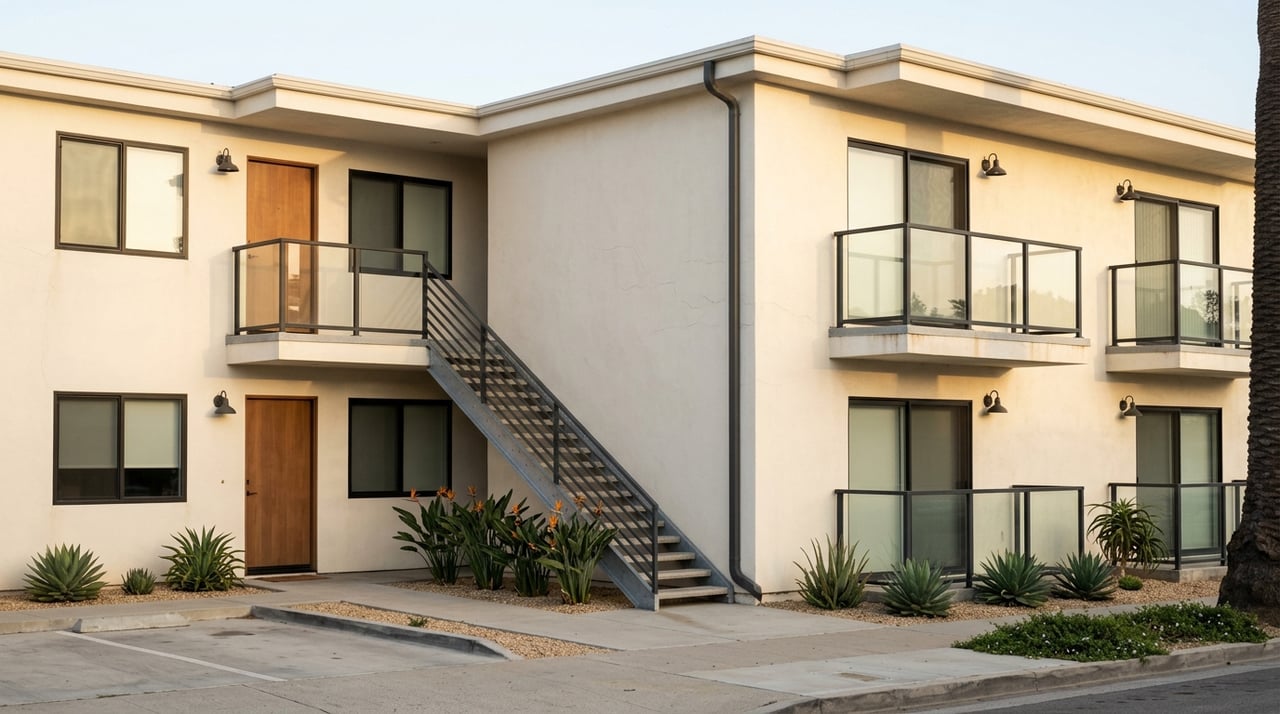
South Oceanside multifamily is not mostly shiny new construction. Public comps and city housing data point to an inventory base made up largely of older, low-rise properties with practical unit mixes and a strong link between condition and performance.
Citywide, Oceanside still leans heavily toward detached housing, but smaller multifamily is a meaningful part of the market. The city housing element reports that 1% of units are duplexes, 6% are in 3-to-4-unit structures, 8% are in 5-to-9-unit structures, 7% are in 10-to-19-unit structures, and 9% are in 20+ unit properties. The largest age cohorts are 1980s-built and 1970s-built housing, which helps frame what many investors are actually buying: older product that may need operational or physical upgrades.
Public South Oceanside comps reinforce that picture. Examples cited in the research include older coastal buildings with one-bedroom and two-bedroom layouts, occasional studios, and an emphasis on parking or garages. A few examples include the 20-unit property at 2030 S Tremont, the 11-unit property at 1036 S Pacific, and the 10-unit ocean-view property at 920 S Pacific.
Rent Levels and Vacancy: Read the Market Carefully
This is an area where it pays to separate headline appeal from actual underwriting. South Oceanside benefits from coastal location and durable renter demand, but recent reports suggest a stable market, not a runaway one.
HUD reported average Oceanside apartment rent at $2,283 in Q2 2024, with vacancy at 4.5% and about 650 apartment units under construction in the city. At the county level, Kidder Mathews’ San Diego multifamily market report shows a similarly balanced backdrop, with 5.4% vacancy, average asking rents of $2,417 per unit, and a 5.0% average cap rate in 1Q 2026.
Neighborhood-level rental asking data show a wide spread. Apartments.com data for South Oceanside lists a neighborhood average around $1,849, with studios around $2,074, one-bedrooms around $1,849, and two-bedrooms around $2,060. That range tells you something important: unit quality, exact location, upgrades, and amenities can have a major impact on achievable rent.
South Oceanside Versus Nearby Coastal Competition
South Oceanside does not operate in a vacuum. It competes with nearby coastal submarkets that often command higher rents and tighter vacancy, especially as you move toward Carlsbad and other North County coastal areas.
According to regional multifamily reporting cited by SD Multifamily, nearby coastal submarkets have shown stronger rent levels and lower vacancy than broader Oceanside in certain periods. That matters because renters with higher budgets may compare options across city lines, while investors may compare South Oceanside pricing against stronger neighboring rent profiles.
The takeaway is not that South Oceanside is weak. It is that the area often attracts buyers because it can offer a more accessible entry point into a coastal location, while still benefiting from scarcity and beach-close demand. For many small-portfolio investors, that balance is exactly the opportunity.
Cap Rates and Pricing Expectations
If you are shopping for multifamily here, expect premium pricing for well-located coastal assets. Public listings in South Oceanside show asking cap rates that can sit below broader county averages, especially for beach-close or ocean-view properties.
The research report cites recent public South Oceanside listings ranging from a 2.82% asking cap rate on a 10-unit ocean-view asset to 3.20% on a 5-unit beach-close property, 3.85% pro forma on a renovated 6-unit community, and 4.72% on a 4-unit value-add opportunity. You can see examples in the 920 S Pacific listing and the 1036 S Pacific listing.
Compared with the countywide 5.0% average cap rate reported by Kidder Mathews, those figures suggest that South Oceanside’s best-located small assets often trade at a premium. In simple terms, you may accept a lower going-in yield in exchange for coastal location, limited supply, and long-term hold appeal.
Where Value-Add Still Makes Sense
For many investors, the real story in South Oceanside is not rapid market rent growth. It is better execution on existing assets. Older buildings give owners room to improve operations, physical condition, and tenant appeal without needing to reinvent the property.
Public listings highlight several recurring value-add themes:
- Interior remodels
- Exterior paint and curb appeal upgrades
- Roof replacement or repair
- Utility and gas line improvements
- Parking or storage improvements
- ADU-related densification where allowed
The 1036 S Pacific listing is one clear example, with marketing centered on renovation and potential for additional units. Other public examples in the research report include properties promoted after major capital improvements or full interior remodels.
For a small investor, this is a useful framework. You may not be able to underwrite a big jump in rents right away, but you may be able to improve leasing, reduce downtime, control expenses, and create a more competitive product within the existing market.
What to Watch When Underwriting
South Oceanside can reward disciplined buying, but it is not a market for loose assumptions. Because many buildings are older and cap rates can be compressed, small underwriting mistakes can materially affect your return.
Focus on these items before you buy:
Property age and capital needs
A large share of Oceanside’s housing stock dates from the 1970s and 1980s, and some public South Oceanside comps are even older. That makes deferred maintenance, major systems, roof condition, and utility infrastructure especially important.
Unit mix and renter fit
Many public comps feature one-bedroom and two-bedroom layouts, with some studios. That mix can support steady demand, but your rent assumptions should reflect the actual unit type, parking setup, and renovation level of the asset you are evaluating.
Supply and concession pressure
HUD reported units under construction in Oceanside, while county reporting shows a market that is stable but not especially hot. In that kind of environment, occupancy can remain healthy, but rent growth may stay modest and concessions may matter more than investors want to admit.
Exit pricing sensitivity
When you buy in a lower-cap-rate coastal pocket, your exit can be more sensitive to shifts in rates, expenses, or market sentiment. That does not mean you should avoid the market. It means your business plan should be built on realistic operations, not optimistic assumptions.
Who South Oceanside Fits Best
This submarket often fits investors who want a coastal foothold and are comfortable with an execution-driven strategy. That can include buyers targeting 4-unit to 10-unit properties, owner-landlords who want to reposition older assets, or small-portfolio investors who value long-term hold quality over short-term speculation.
It may be especially appealing if you want a property where hands-on leasing, maintenance coordination, and expense management can move performance. In a market like South Oceanside, strong operations can be just as important as acquisition price.
Final Takeaway for Investors
South Oceanside offers something many investors want but few submarkets can fully deliver: a coastal location, constrained housing supply, steady renter demand, and a stock of smaller multifamily assets that still leave room for improvement. At the same time, it is a market where premiums are real, rent growth may be moderate, and older buildings demand careful diligence.
If you approach the area with realistic underwriting and a clear operating plan, South Oceanside can make sense as a long-term multifamily play. If you want help evaluating a coastal small-asset acquisition, repositioning an older building, or planning for post-close leasing and management, OC Investments & Management can help you think through the numbers and the day-to-day execution.
FAQs
What makes South Oceanside attractive for multifamily investing?
- South Oceanside offers a coastal 92054 location, limited new land supply, beach access, and renter demand supported in part by Camp Pendleton and the broader Oceanside housing market.
What types of multifamily properties are common in South Oceanside?
- Public comps suggest that many local assets are older, low-rise buildings with one-bedroom and two-bedroom units, occasional studios, and features like parking or garages.
What are rents like for South Oceanside rentals?
- Rental asking levels vary widely by condition and location, with neighborhood data showing a mix of lower-priced older inventory and higher-priced upgraded or coastal-close units.
Are South Oceanside cap rates lower than the broader San Diego market?
- Often, yes. Public listings in South Oceanside show asking cap rates below broader county averages, especially for beach-close and ocean-view assets.
What value-add opportunities exist in South Oceanside multifamily properties?
- Common value-add opportunities include interior renovations, exterior improvements, roof and utility upgrades, parking or storage enhancements, and possible ADU-related densification where allowed.
What should investors watch when buying older South Oceanside buildings?
- Pay close attention to deferred maintenance, major systems, unit mix, realistic rent assumptions, supply pressure, and how compressed cap rates may affect your exit strategy.